
Direct answer: This Facebook lead generation for hospitals case began with a U.S. hospital paying about $40 per reported result through in-house advertising. After the account moved into a controlled agency test, the reported average fell to approximately $20–$30 per result in about a week. The useful lesson is the testing discipline: lower acquisition cost matters only when the hospital can define the result, respond quickly, and confirm that the leads are genuine and serviceable.
Hospital advertising has a narrow margin for sloppy measurement. A form submission can look like a success in the ad account while producing little value for the intake team. That is why this case is more useful than a simple “cost went down” claim. It shows a change in the operating model: the hospital moved from two years of self-managed buying to a short, measurable test designed to control spend and improve outcomes.
Facebook lead generation for hospitals: the starting point
The hospital had been running its own campaigns for roughly two years. The case record describes annual costs increasing while competition in the market became more intense. That combination creates a familiar pressure: the team needs more inquiries, but it also needs a defensible explanation for every dollar spent.
The first decision was to avoid treating the existing account as a finished system. Instead, the campaign was moved into a test period. The test ran for about one week, long enough to compare the existing baseline with a new setup, but short enough to limit wasted spend while the team learned.
| Measure | Before the test | Reported after the test | What must be confirmed |
|---|---|---|---|
| Campaign owner | Hospital in-house team | External campaign test | Scope of management and account access |
| Reported cost | About $40 per result | About $20–$30 per result | Conversion definition and attribution window |
| Test period | Self-managed for about two years | About one week of testing | Exact start and end dates |
| Client response | Costs rising | Strong client feedback reported | Feedback source and approval for quotation |
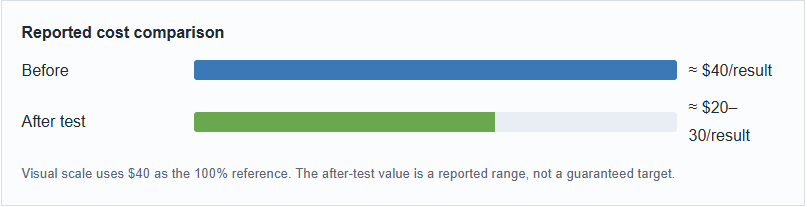
Reported cost comparison
Why the result is more than a cheaper number
The reported change is meaningful because it is tied to a specific baseline. Moving from roughly $40 to $20–$30 per result suggests a potential 25%–50% reduction against the old cost, depending on where the new range landed. That calculation is a directional comparison, not a full return-on-investment analysis. It does not tell us the number of leads, the percentage that were qualified, or the eventual patient value.
For a hospital, the next question is operational: could the intake team contact the leads and move the right people toward the next step? Meta describes lead-generation campaigns as a way to collect prospect information through ad experiences such as forms or messaging. That convenience makes form design, consent language, routing, and response ownership part of performance marketing rather than paperwork after the ad goes live.
Data note: The supplied case deck uses “result” without defining whether it means a form submission, qualified inquiry, booked appointment, or another event. Keep the number in a draft until the team confirms the event and reporting window.

What to document in a hospital campaign test
A useful case study records the test as a chain of decisions. Start with the old setup and its reporting definition. Then document what changed: audience, creative, budget structure, form questions, landing flow, or follow-up process. Finally, show the result with the same denominator and a clear time window.
Healthcare teams should also keep the content and data workflow visible. A lower cost is not a reason to weaken patient privacy, consent language, or internal review. Meta’s Advertising Standards and the U.S. Department of Health and Human Services’ HIPAA marketing guidance are sensible starting points for a compliance review, but the final workflow depends on the service, jurisdiction, and organization.
Next step for a marketing team: Before scaling, build a one-page test log with the conversion definition, dates, spend, lead volume, qualified-lead rate, response time, and disposition of each change.
What this case proves—and what it does not
The case supports a narrow conclusion: a U.S. hospital moved from rising self-managed costs to a reported $20–$30 average cost per result after about a week of testing, compared with a previous figure of about $40. It also records positive client feedback.
It does not prove a permanent cost, a universal hospital benchmark, or a patient-acquisition return. Those claims would require a longer period, a defined conversion, lead-quality data, and downstream outcomes. Keeping that boundary in the article makes the evidence stronger, not weaker.
For campaign owners: Use a qualified-lead review to decide whether the lower reported cost should become the next campaign baseline.

How to run a controlled Facebook hospital lead test
- Define one conversion event and write it down before launch.
- Separate the test budget from the ongoing budget so the learning period is visible.
- Review audience, creative, form questions, and follow-up ownership as one lead journey.
- Check lead quality and response speed every day, not only the platform cost.
- Compare the test period with a clearly stated prior period using the same metric.
- Keep the lower-cost configuration only after the downstream team confirms that lead quality is acceptable.
Frequently asked questions
What was the original cost per result for the hospital campaign?
The case record reports an initial cost of about $40 per result before the controlled test. It does not define the conversion event, so the result type should be confirmed before publication.
What did the Facebook campaign achieve after the test?
The reported average cost moved to roughly $20–$30 per result after about one week of testing. The campaign record also notes strong client feedback.
Why is a one-week test useful for a hospital campaign?
A short test can reveal whether the account has a workable combination of audience, creative, offer, and lead-flow settings. It is a diagnostic window, not proof that the same cost will hold indefinitely.
Should hospitals use lead forms or send people to a website?
Either can be appropriate. A native form can reduce friction, while a website may give the patient more context. The choice should follow the service, consent process, lead-quality requirements, and local policy.
What should a hospital measure besides cost per lead?
Measure qualified lead rate, contact rate, appointment rate, time to response, duplicate rate, and downstream revenue or service value. Cost alone can reward low-quality submissions.
Can this result be generalized to every hospital?
No. The case is a documented campaign observation for one hospital account. Results depend on market, service line, geography, seasonality, creative, budget, and the definition of a result.
What should be verified before publishing the case study?
Confirm the conversion definition, dates, currency, attribution window, lead volume, qualified-lead rate, and whether the quoted cost includes media only or management fees.